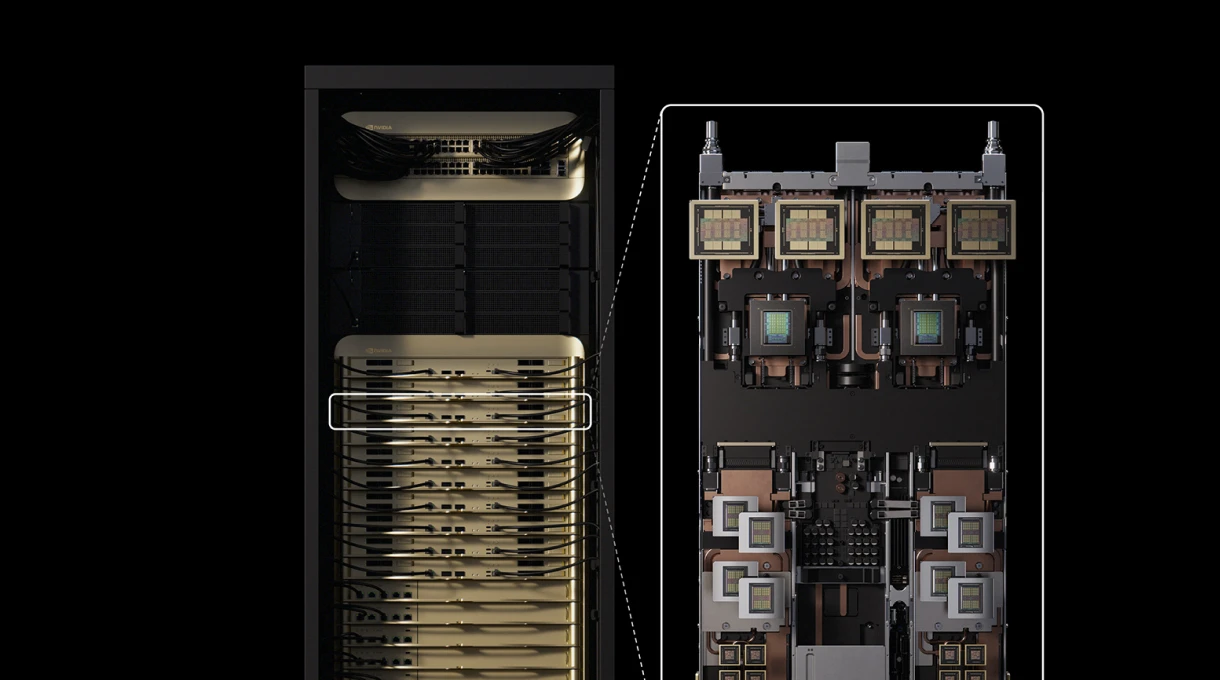
Most of what you build for Nebius-hosted NVIDIA Grace Blackwell NVL72 carries over to NVIDIA Vera Rubin NVL72
Teams planning NVIDIA Vera Rubin NVL72 ask us what we had to ask ourselves: we built for NVIDIA Grace Blackwell rack-scale systems, so how much must be done again? We tested both platforms, and most of it carried over: the Arm image family, node layout, and scheduling stay; images need a newer NVIDIA CUDA base, and kernels compiled only for Blackwell Ultra need a rebuild. Here is what we ran, what we found, and what we recommend.
LayerStream: faster MoE fine-tuning on fewer or cheaper GPUs
Fine-tuning a large MoE model can require extra GPUs just to hold the training state. LayerStream moves state through GPU memory one layer at a time. See how the Nebius training engine delivers faster iteration, uses fewer or lower-priced GPUs, and compares with our Megatron-based trainer across three models.
Production AI Agents for Generative Media: a free course from Nebius and DataTalks.Club
Introducing Production AI Agents for Generative Media, a free, open-source course from Nebius and DataTalks.Club for engineers who need media generation to work at production scale. Over four modules and a capstone, you build an agent that creates an image and a voice or video asset, checks quality, retries failures, and scales to more than 1,000 records while tracking the cost of every asset.
What your retail inference bill looks like at peak season and how to keep it under control
As retail AI traffic spikes during peak shopping seasons, inference costs can quickly eat into margins. In this article, we explore where those costs come from and how retailers can control them by optimizing models, agent harnesses and the systems around them — while meeting their applications’ quality and latency requirements.
Running Cross-rack NIXL-EP on GB300
Cross-rack NIXL-EP over InfiniBand on GB300 failed during setup on SGLang 0.5.12 and 0.5.16, with a log that blamed a missing nvidia_peermem module. The real cause was a DMA-BUF registration failure inside the older NIXL packages. An image that bundles NIXL 1.4.0 or later, plus UCX_TLS=^cuda_ipc, fixed it; the post shows how to prove DMA-BUF is in use.
Nebius celebrates startups from model-builders to meal-assembly robots at 2026 Physical AI Awards
Nebius names the winners of its second annual Physical AI Awards: Archetype AI, Outsight, Luminary, Chef Robotics and LanceDB, one for each layer of the physical AI stack. This post covers what 363 applicants revealed about where the field is heading and how the physical AI startup ecosystem is changing.
MLPerf® Training v6.1: Nebius ranks 1st on NVIDIA Vera Rubin at rack scale in pre-training and post-training
Today we’re announcing our latest submission to MLPerf® Training v6.1, the industry-standard benchmark for AI training performance developed by MLCommons®. This round marks a generational step for Nebius: our first MLPerf® Training results on the NVIDIA Vera Rubin platform. In this blog we’re also sharing updated MLPerf® Inference v6.1 results, now measured on an Available NVIDIA Vera Rubin NVL72 system.
Fine-tuning, RL, or distillation? How to choose a post-training method
Choose a post-training method by the feedback your team can produce. Compare SFT, preference tuning, RL, and distillation, then evaluate the adapted model against your quality, latency, and cost targets.
Up to 5× faster RL training, no extra GPUs
Our internal RL auto-tuner profiles each training step, forecasts which configuration changes will help, and tests them in real runs. On NVIDIA B300 GPUs across four models and two workloads, it made steps 1.42–4.93× faster on the same GPU budgets, with a 3.5× median. Five lessons from 210 runs, including why a faster inference engine did not speed up training.
Why NUMA affinity matters for distributed training on Kubernetes: 1.1% more throughput from one torchrun flag
We measured what one torchrun flag does for DeepSeek V3 pretraining on 192 NVIDIA B300 GPUs in Managed Service for Kubernetes on Nebius AI Cloud: --numa-binding=exclusive cut mean step time by 1.11% and raised throughput per GPU by 1.13%. This post explains how NUMA-aware process placement works, how it compares with Slurm’s task binding, and how to test it on your own training job.
torchrun
--numa-binding=exclusive
Nebius and Positronic launch the Physical AI Competition: from simulation to a real robot
Nebius and Positronic are running an open competition in robot manipulation on the DROID setup, a Franka arm with a Robotiq gripper. Teams train on Nebius AI Cloud and compete in simulation until 13 December; the top 10 policies then run on a real arm in December. Prizes total $20K+ in Nebius GPU credits and Positronic evaluation credits, and no team needs a robot of its own.
Nebius at GTC Berlin: “no tagline needed”
A first-person recap of Nebius Build Week and GTC Berlin from developer advocate Marouane Khoukh. The Sunday hackathon at CODE University drew more than 250 builders and produced 74 projects, including a children’s news show scripted with NVIDIA Nemotron on Nebius Token Factory and a robot arm whose team found real demonstrations made the biggest difference.
Loading results…