
Nebius and Positronic launch the Physical AI Competition: from simulation to a real robot
Nebius and Positronic launch the Physical AI Competition: from simulation to a real robot
Today we’re launching the Nebius × Positronic Physical AI Competition with our partners at Positronic Robotics. Teams compete in simulation until 13 December, the top 10 run on a real robot arm in December, and the prizes total $20K+ in Nebius GPU credits and Positronic evaluation credits. Register at competition.phail.ai.
A new robot model arrives almost every month, and each one comes with its own demo video. There are still few fair ways to compare them. Labs often test on their own robots, with their own tasks and their own idea of success, so a result from one lab says little about a model from another.
The best open model completes about 70% of real-robot DROID tasks
Real-robot tests show how much is still open. On the DROID: Everyday tasks board at PhAIL.ai, open models have run more than a thousand episodes across more than a hundred common tasks, all on the same Franka arm. Even the best of them completes only about 70% of tasks on average, and the weakest about 12%. Robotic manipulation is far from solved, and the gap between models is wide enough for a small team with a good idea to make a difference.
The same rules for every team
Open challenges with shared rules have marked turning points before. In the 2004 DARPA Grand Challenge, no autonomous vehicle finished the course. A year later, five did.
The Nebius × Positronic Physical AI Competition follows the same idea: every team works on the same tasks, under the same rules, and is scored the same way. Positronic runs the evaluation as an independent party. They test physical AI models on real robots and run PhAIL.ai, the public leaderboard they launched with Nebius as a founding partner.
Jonathan Lwowski, Field CTO of Physical AI at Nebius, comments, “Physical AI improves when teams can train, test, learn, and repeat quickly. Simulation helps teams move faster and make better use of real-world data that’s hard to collect. Testing on real robots then shows them what to fix next. With the Nebius × Positronic competition, we’re bringing that loop together, so more teams can train and test in simulation on Nebius AI Cloud, then evaluate their models on real hardware.”
Built on the most common open robot setup
The competition uses the DROID setup: a Franka arm with a Robotiq gripper, one of the most widely used setups in open robot-learning research. The public DROID dataset holds 76,000 demonstrations collected across 564 scenes. Several open models ship DROID checkpoints, among them NVIDIA Cosmos 3 Nano, NVIDIA Isaac GR00T and π0.5, and NVIDIA Cosmos 3 Nano currently leads PhAIL’s real-robot DROID board. Teams start from a working model and public data.
The same setup exists in simulation and on real hardware. Simulation is where teams iterate fast, and every submission gets a score there. But a model that succeeds in simulation does not always succeed on a real robot: contact, friction, and timing behave differently on hardware. That is why the real robot decides the winners.
A real-robot test without a robot lab
Most teams can rent a GPU in minutes. Very few can test their model on a real robot arm. In this competition, teams train on Nebius AI Cloud, submit their model as a container, and the finalists get a real-robot evaluation from Positronic, with no hardware of their own. It is the loop we build toward with the Nebius Physical AI Workbench: train and validate in simulation, then promote the best models to real-world testing.
Sergey Arkhangelskiy, CEO, Positronic, explains: “We built PhAIL to show how robot models really perform on real hardware. This competition opens that test to everyone: you don’t need your own robot, only a good idea. In December the ten best policies run on our arm, and I’d love to see a team nobody has heard of beat the big labs.”
How to join
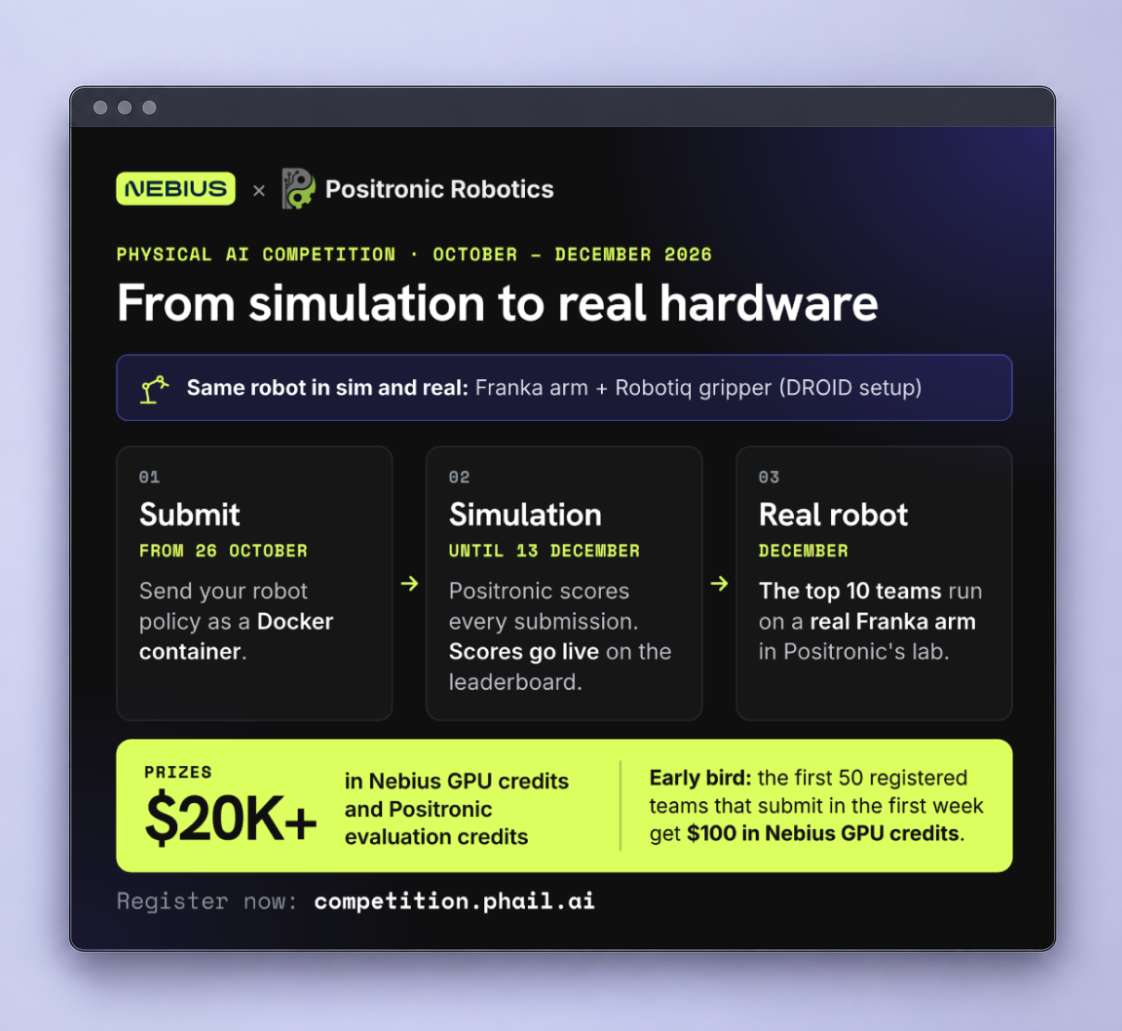
The competition is live. Register at competition.phail.ai. Submissions are open now, and final entries close on 13 December. If you’re one of the first 50 registered teams and you submit in the first week, you’ll get $100 in Nebius GPU credits.
Spend your time on the model, not on building a robot lab. May the best policy win!
Explore Nebius Token Factory

See also
Customers using Nebius Physical AI Workbench report up to 40% less engineering time with AI agents operating robotics workflows directly. Built in collaboration with NVIDIA and open source on GitHub, it runs data generation, simulation, training, and evaluation in one place. This release adds NVIDIA Cosmos Data Factory and a sim-to-real workflow co-designed with Sereact for Zalando returns.
Nebius Academy and NVIDIA are launching an education collaboration at GTC Berlin, featuring: NVIDIA Deep Learning Institute (DLI) open-source courses hosted on Nebius Academy starting with Fundamentals of Deep Learning, co-developed courses in agentic and physical AI that run on Nebius, and Nebius GPU compute behind NVIDIA DLI’s sold-out full-day workshop at GTC.

The results are in for the Nebius Serverless AI Builders Challenge. In total, 35 projects qualified across AI & ML, Scientific AI & Healthcare, and robotics, each with a public repo and a technical blog post. Discover the top three winners, special award recipients, and cast your vote for the Community Choice award.