
Running Cross-rack NIXL-EP on GB300
Running Cross-rack NIXL-EP on GB300
Cross-rack NIXL-EP over InfiniBand on GB300 failed during setup on SGLang v0.5.12-cu130 and v0.5.16-cu130. The managed node image has nvidia_peermem disabled and the NIXL packages in those images cannot register GPU memory with the NIC through DMA-BUF. With an image that bundles NIXL 1.4.0 or later (lmsysorg/sglang:v0.5.20 ships NIXL 1.4.1 on UCX 1.22.0) and UCX_TLS=^cuda_ipc set, NIXL-EP initialized on every rank on stock managed nodes with no host module and no privileged pod.
TL;DR
Cross-rack NIXL-EP (SGLang MOE_A2A_BACKEND=nixl) over InfiniBand on GB300 works on stock managed nodes with no host module and no privileged pod. Two things are required:
-
Use an image bundling NIXL 1.4.0 or later (i.e. SGLang 0.5.20+). Earlier NIXL packages cannot use DMA-BUF and the managed GB300 node image has
nvidia_peermemdisabled on purpose:NVIDIA recommends using DMA-BUF when it is supported… [it] does not require the GPU Operator to build and load the legacy nvidia-peermem kernel module.
Source: GPU Operator: GPUDirect RDMA
-
Set
UCX_TLS=^cuda_ipcto avoid setting up an IPC path in the device memory.
NIXL Background
NIXL (NVIDIA Inference Xfer Library) is a general point-to-point transfer library for inference, sitting over UCX and friends. Its headline use is disaggregated serving: prefill workers hand the KV cache for a finished prompt to the decode worker that will continue it. Those are large, self-contained blocks moved once per request, off the per-token critical path, and the CPU has time to post the transfer. vLLM’s KV connector runs over rc_mlx5 by default.
NIXL-EP is a different consumer of the same library: the expert-parallel all-to-all for MoE models. In each MoE layer the process has four steps:
- A token’s hidden state is calculated.
- The router identifies its targeted experts.
- Dispatch: the token’s hidden state (KB-scale) is sent to the GPUs holding the targeted experts.
- Combine: each expert’s output comes back to the token’s owning rank.
That is thousands of tiny messages per step on the critical path of every token with destinations that are not known until the router has run.
| NIXL (disaggregated serving) | NIXL-EP (MoE all-to-all) | |
|---|---|---|
| Type | KV-cache blocks | token hidden states |
| Size | MB-scale | KB-scale |
| Frequency | once per request | twice per decode step per layer |
| Issued by | the host | CUDA kernel threads |
| UCX transport | rc_mlx5 |
rc_gda |
At KB-scale message sizes a CPU round trip to post each transfer would cost more than the transfer so NIXL-EP uses UCX’s GPU-initiated path instead where the host is bypassed and the kernel talks directly to the NIC. At the core of this is the UCX transport rc_gda (GPU Direct Async — Kernel Initiated, “GDAKI”).
NIXL-EP and DMA-BUF
UCX picks a set of lanes per peer. Most traffic uses rc_mlx5 (ordinary CPU-initiated RDMA) where the CPU posts work requests to the NIC. NIXL-EP’s MoE dispatch/combine instead uses UCX’s GPU-initiated device API, the rc_gda transport.
With GDAKI, CUDA kernel threads write work requests into the NIC’s send queue and ring its doorbell themselves with no CPU in the loop. For that to work the queue buffers live in GPU memory and UCX registers them with the NIC through mlx5 DEVX as UMEM. The kernel then has to map that GPU memory for the NIC by one of two routes:
- DMA-BUF: CUDA exports the GPU allocation as a file descriptor the NIC driver imports
nvidia_peermem: the legacy kernel module (disabled on the managed image)
UCX_IB_GDA_DMABUF_ENABLE defaults to try: DMA-BUF first, silent fallback to nvidia_peermem. This can lead to misdiagnosing the issue, as the default log level only shows the failure as a missing nvidia_peermem module:
gdaki.c:1144 UCX  DIAG  GDAKI not supported, please load Nvidia peermem driver by running "modprobe nvidia_peermem"
gdaki.c:1489 UCX  DIAG  mlx5_0: GPU-direct RDMA is not available (GDA_DMABUF_ENABLE=try)
ucp_device.c:497  UCX  ERROR no lane found for ep=0xfff914020200
ucp_device.c:599  UCX  ERROR failed to pack uct memory element for element=11
ucp_device.c:703  UCX  ERROR failed to create handle: No such device
ucx_backend.cpp:1467] Failed to prepare remote memory view: Failed to create device memory list(remote): No such device
The log reads “load Nvidia peermem” which is the legacy approach. It never mentions that DMA-BUF was tried first and failed. Raise the log level (UCX_LOG_LEVEL=debug) and the real cause appears in a very verbose log:
cuda_copy_md.c:110  UCX  DEBUG dmabuf is supported on cuda device 0
ib_md.c:1260        UCX  DEBUG mlx5_0: dmabuf is supported
gdaki.c:191         UCX  DEBUG DEVX UMEM doesn't support DMA-BUF
gdaki.c:1484        UCX  DEBUG mlx5_0:
Failed run:
To avoid the silent fallback, you can set UCX_IB_GDA_DMABUF_ENABLE=yes.
What was failing
On SGLang v0.5.12-cu130 and v0.5.16-cu130 (NIXL 1.1.0 and 1.3.2, both on UCX 1.21), the DEVX UMEM registration fails inside the NIXL package. With peermem disabled on the managed image, that leaves no way to map GPU memory for the NIC:
gdaki.c:191   UCX DEBUG DEVX UMEM doesn't support DMA-BUF
              UCX DEBUG GPU-direct RDMA is not available (GDA_DMABUF_ENABLE=try)
That registration is what creates an rc_gda device. Without it UCX offers no cuda{gpu}-mlx5_{hca}:1 resource, builds no rc_gda interface, and gives no endpoint lane tagged device. Only ordinary rc_mlx5 lanes are created which is why NCCL and ucx_perftest pass on the same nodes. prepMemView accepts nothing else so NIXL-EP dies during setup:
no lane found → Failed to create device memory list(remote): No such device
RuntimeError: Assertion error nixl_ep.cpp:1350 '... prepMemView(...) == NIXL_SUCCESS'
What worked
| SGLang image | NIXL / UCX | One rack | Two racks | Cross-rack GPU memory path |
|---|---|---|---|---|
lmsysorg/sglang:v0.5.12-cu130 |
1.1.0 / 1.21 | Success | Fail | peermem only |
lmsysorg/sglang:v0.5.16-cu130 |
1.3.2 / 1.21.0 | Success | Fail | peermem only |
lmsysorg/sglang:v0.5.20 |
1.4.1 / 1.22.0 | Success | Success | DMA-BUF |
lmsysorg/sglang:v0.5.22 |
1.5.0 / 1.23.0 | Success | Success | DMA-BUF |
NIXL-EP initialized on every rank and distributed generation returned “Paris” with the image-native NIXL/UCX, no UCX_NET_DEVICES, no privileged pod, and no nvidia_peermem.
env:
- name: MOE_A2A_BACKEND
  value: nixl
- name: DEEPEP_MODE
  value: low_latency
- name: EP_SIZE
  value: "16"                     # 8 for one rack
- name: UCX_TLS
  value: ^cuda_ipc                # required (see below)
- name: SGLANG_NIXL_EP_BF16_DISPATCH
  value: "1"
- name: SGLANG_DEEPEP_BF16_DISPATCH
  value: "1"                      # DeepEP-named, but SGLang's expert layer checks it
                                  # for the NIXL dispatcher too; without it 0.5.20 fails
                                  # on "forward_deepgemm_masked is deprecated"
UCX_TLS=^cuda_ipc is not optional. The leading ^ means “everything except this”. Without it, UCX puts a cuda_ipc lane in the device memory view for a peer in another node; importing that peer’s CUDA fabric handle fails and the job either asserts in prepMemView or silently generates garbage:
cuda_ipc_cache.c:333  UCX ERROR cuMemMap(...) failed: operation not supported
ucp_device.c:540      UCX ERROR failed to pack uct memory element for lane=4
In a nine-variant ablation on 0.5.20 (two racks, four nodes), every variant that kept ^cuda_ipc passed and both that dropped it failed, with these failures:
- A
prepMemViewassertion - Corrupted output (
" the......"instead of “Paris”)
Cross-rack means cross-IMEX-domain so CUDA IPC cannot reach the peer.
Leave UCX_NET_DEVICES unset. NCCL_IB_HCA does not configure UCX and a NCCL-style list (mlx5_0:1,...) hides every cuda{gpu}-mlx5_{hca}:1 GDA device causing UCX to find no device lane. Auto-discovery picks the right four rc_mlx5 and four rc_gda devices.
Resolution in layers
Three layers have to agree for rc_gda to come up:
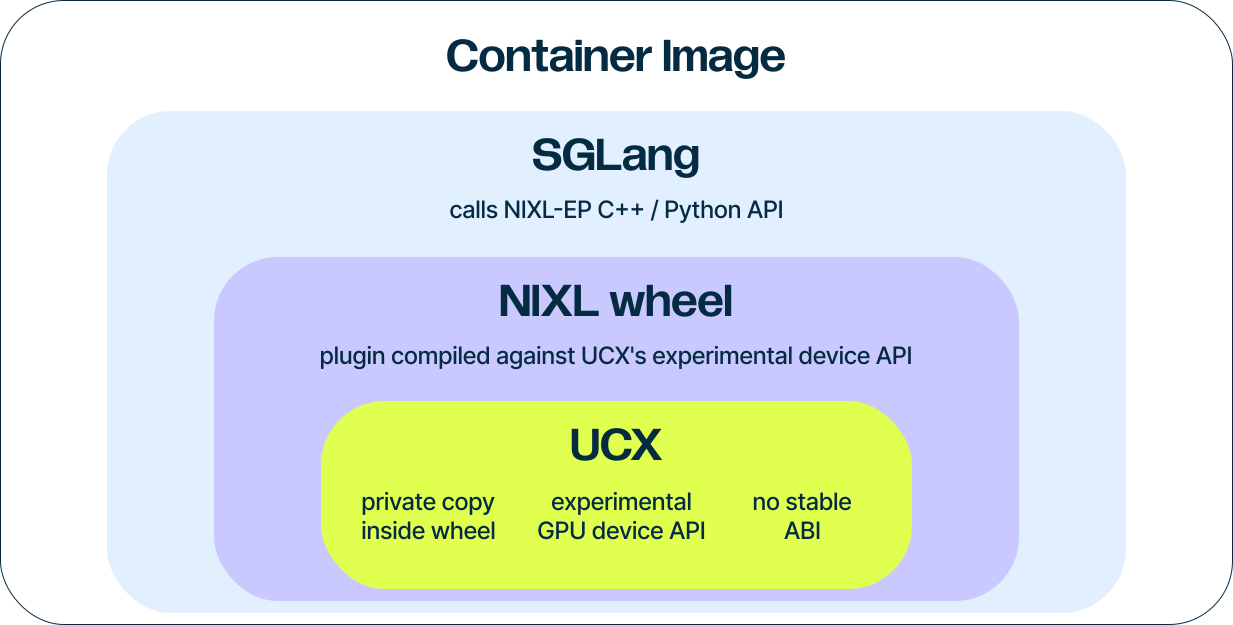
Upgrading components individually leads to failure:
- Injecting UCX 1.22.0 source builds into SGLang 0.5.16 / NIXL 1.3.2 fails the DEVX DMA-BUF check. Note that since NIXL uses a private copy of UCX, UCX has to be injected into the NIXL wheel which can break the ABI reference.
- Upgrading NIXL leads to an API reference break between SGLang and NIXL (
topk_idxtype mismatch).
This tight bundling between each layer means the image has to be upgraded, not patched, for NIXL-EP to work as intended.
Verifying DMA-BUF
The default try mode cannot prove DMA-BUF since peermem becomes a silent fallback. To force DMA-BUF:
- name: UCX_IB_GDA_DMABUF_ENABLE
  value: "yes"      # DMA-BUF only, no peermem fallback
- name: UCX_LOG_LEVEL
  value: debug      # ~10k lines per node; remove afterwards
Pass looks like this (each of the four nodes logged it four times):
ib_md.c:1318   mlx5_0: cuda GPUDirect RDMA is not detected by checking /sys/module/nvidia_peermem/version
ib_md.c:1345   mlx5_0: dmabuf is supported
gdaki.c:289    mlx5_0: using dmabuf for gda transport
wireup.c:1487  ep: lane[7]: 19:rc_gda/cuda0-mlx5_2:1.0 ... device
Fail is DEVX UMEM doesn't support DMA-BUF → GPU-direct RDMA is not available → no lane found → the prepMemView assertion.
Ignore NIXL’s 4 IB device(s) were detected, but accelerated IB support was not found!. This is a false negative for rc_gda; the same process’s UCX trace shows DMA-BUF rc_gda lanes being created and selected.
Successful run:
Other users of NIXL device API
NIXL’s device API (nixl::gpu, nixlPut, nixlAtomicAdd, nixlGpuGetXferStatus, with memory views prepared host-side by prepMemView) was deliberately layered to be backend-neutral. UCX is currently the only backend that implements it and is seen in the following use-cases:
- NIXL-EP
- vLLM MLA decode context parallelism: vLLM adds a NIXL device-API backend for the output/LSE all-to-all, behind
VLLM_USE_NIXL_DCP_A2A=1with--dcp-comm-backend a2a. Per the PR, this was validated on NIXL 1.5.0. - CuTe DSL kernels (open NIXL issue 2399): the request is for the device API to be inside CuTe DSL kernels so a compute kernel can pack KV and transfer it without a separate comm kernel. The implementation is complete but not yet merged (NIXL pull request 2401). Anything built on it inherits the experimental device API underneath.
What to set before running cross-rack NIXL-EP
Upgrade the whole SGLang image to one that bundles NIXL 1.4.0 or later: injecting UCX 1.22.0 into SGLang 0.5.16 and upgrading NIXL alone both failed. Set UCX_TLS=^cuda_ipc, leave UCX_NET_DEVICES unset, and run once with UCX_IB_GDA_DMABUF_ENABLE=yes to confirm DMA-BUF before trusting a pass in the default try mode.
Runnable manifest, DRA resources, smoke script, and run steps: nebius/ml-cookbook → k8s/nixl
FAQ
Explore Nebius Token Factory

See also

Today we’re announcing our latest submission to MLPerf® Training v6.1, the industry-standard benchmark for AI training performance developed by MLCommons®. This round marks a generational step for Nebius: our first MLPerf® Training results on the NVIDIA Vera Rubin platform. In this blog we’re also sharing updated MLPerf® Inference v6.1 results, now measured on an Available NVIDIA Vera Rubin NVL72 system.

SemiAnalysis has named Nebius a Platinum AI cloud provider, the top tier of its ClusterMAX™ 3.0 rating. The rating is based on live testing of production clusters: burn-ins, storage under concurrent load, and automated failure recovery on real NVIDIA GB300 and NVIDIA HGX B300 hardware. This post covers what the testing found and why it matters for teams choosing where to run production AI.

Nebius was built on the conviction that AI must stay competitive and diverse. Open source is essential to keeping it that way.