
OpenAI GPT-OSS models inference
Run OpenAI’s open-weight GPT-OSS reasoning models with predictable latency, long-context stability, and enterprise controls for agentic workloads.

Configurable reasoning depth
Tune reasoning effort to balance latency and accuracy for agent loops and multi-step planning.

Long-context stability (131K)
Cache-aware routing and prefill optimizations keep latency and cost predictable across long sessions.

Tool-native outputs
Reliable function-calling and structured responses for safe agent execution and easier orchestration.

Lower cost per decision
Fewer retries and shorter agent loops reduce total cost per task, not just cost per token.

Production post-training
Optional calibration, distillation, and sampler tuning based on real traffic to preserve reasoning quality at scale.

Enterprise controls & zero retention
Dedicated endpoints, RBAC, region-locking, and zero-retention options for regulated workloads.
Choose your GPT-OSS model
gpt-oss-120B
Frontier reasoning model for complex, multi-step tasks.
Best for: agentic systems, planning, research, complex coding
- 131K context
- Apache 2.0 open license
Capabilities:
- Deep reasoning
- Native tool use
- Structured outputs
- Fine-tuning support
gpt-oss-20B
Efficient reasoning model with high throughput
Best for: cost-sensitive agents, coding assistants, scalable inference
- 131K context
- Apache 2.0 open license
Capabilities:
- High throughput
- Tool use
- Structured outputs
- Cost-efficient
Benchmarks
GPT-OSS models deliver competitive frontier-level reasoning across standard evaluations. The 120B model targets maximum reasoning depth, while the 20B variant balances strong performance with higher throughput and lower cost.
AIME (2024–2025)
- Strong multi-step mathematical reasoning.
- 120B approaches frontier-level scores.
- 20B maintains high accuracy relative to its size.
MMLU / GPQA
- Broad general reasoning and knowledge coverage.
- 120B leads on complex domain tasks.
- 20B offers strong cost-performance efficiency.
SWE-Bench
- Reliable code reasoning and structured task execution.
- Both models support tool use and structured outputs.
Benchmarks measure accuracy. At scale, tail latency, retry rates, and cache efficiency dominate real cost. Nebius Token Factory optimizes for those production signals.
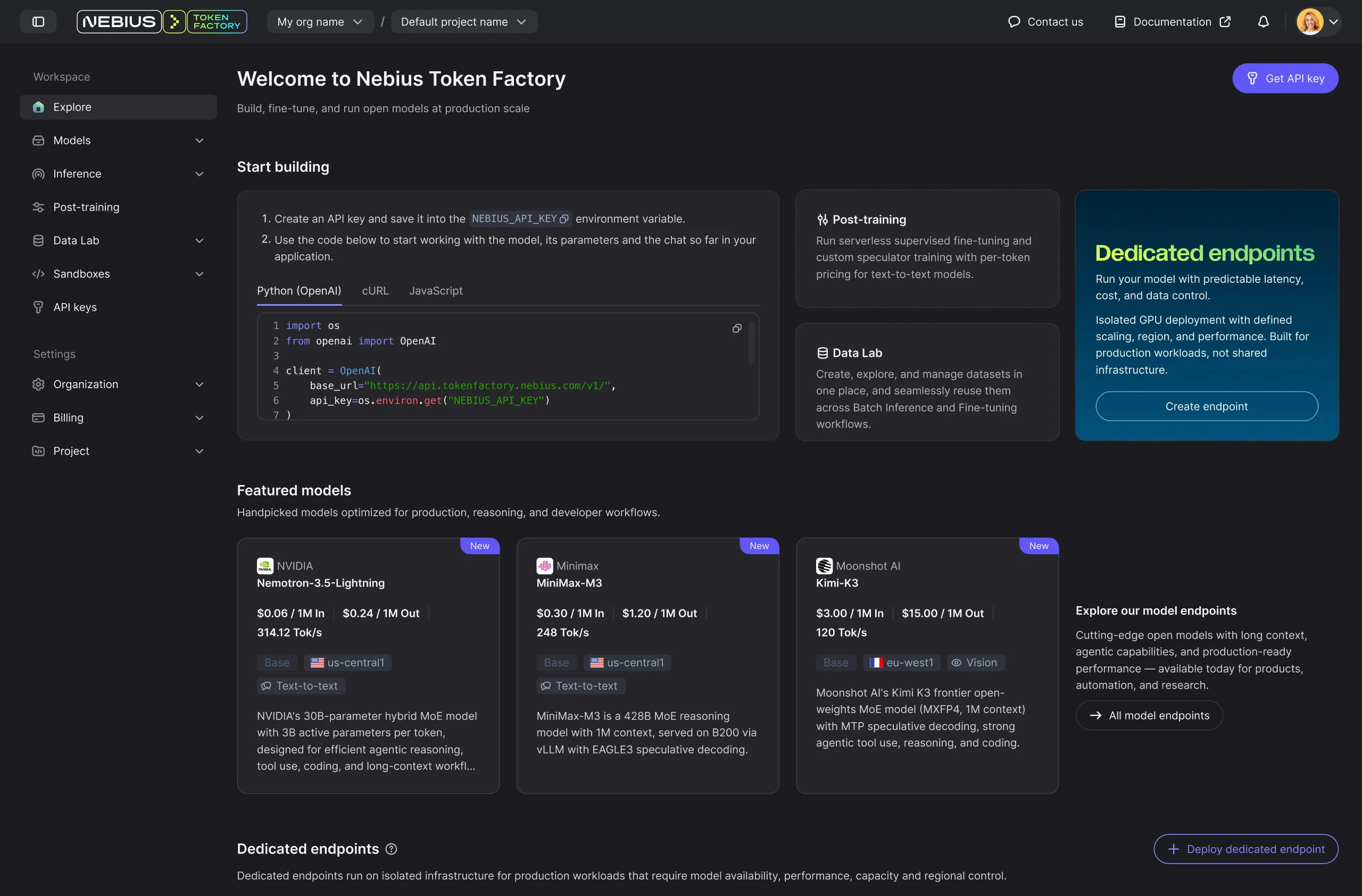
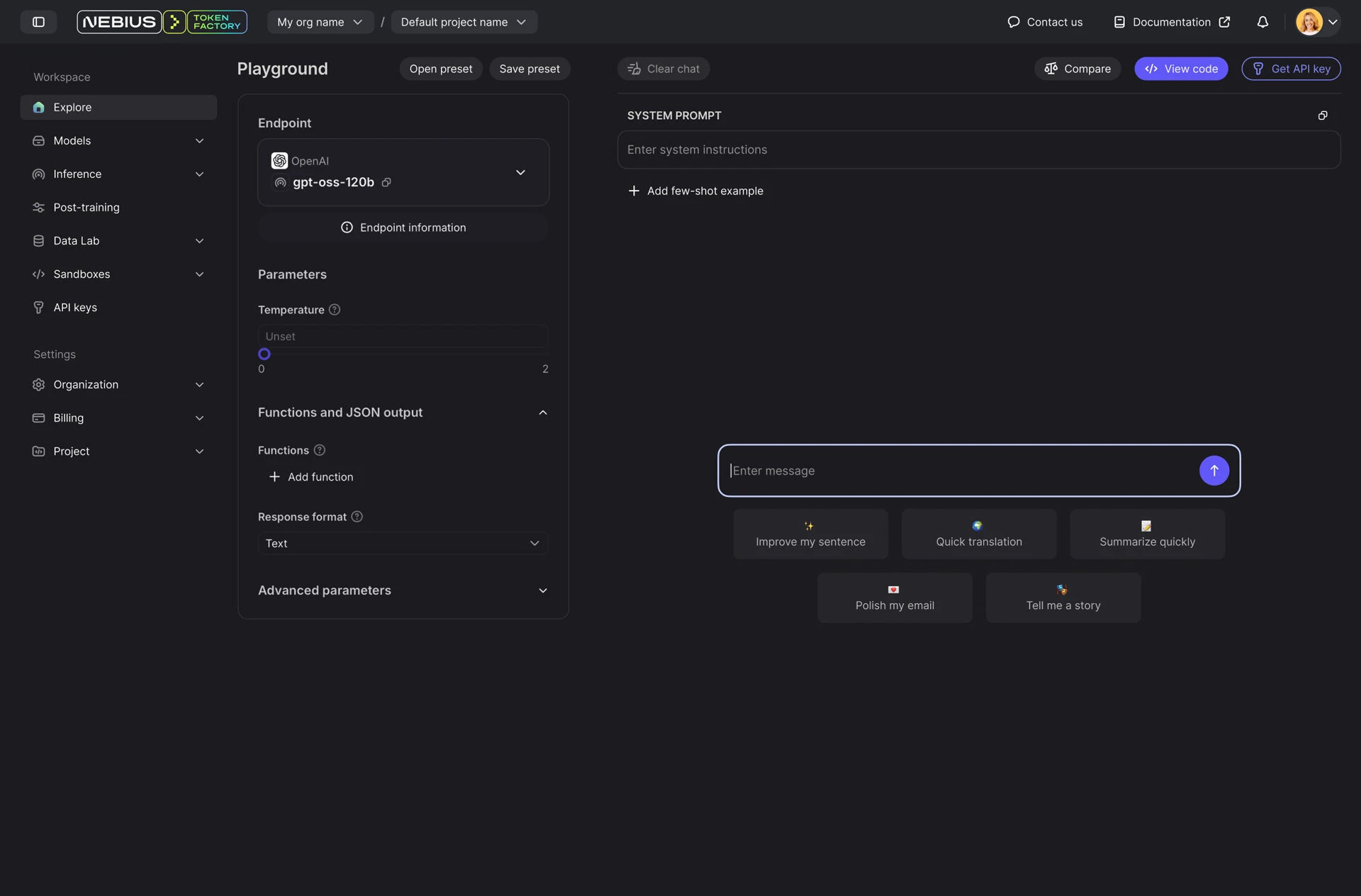
A simple and friendly UI for a smooth user experience
A simple and friendly UI for a smooth user experience
Use the Playground to compare reasoning depth, tool-call fidelity, and cost behavior across GPT-OSS models. Refine prompts, test agent flows, and export production-ready API snippets when you’re ready.
Familiar API at your fingertips
import openai
import os

client = openai.OpenAI(
    api_key=os.environ.get("NEBIUS_API_KEY"),
    base_url='https://api.tokenfactory.nebius.com/'
)

completion = client.chat.completions.create(
    messages=[{
        'role': 'user',
        'content': 'What is the answer to all questions?'
    }],
    model='openai/gpt-oss-120b'
)
Choose how to run GPT-OSS
Deployment option
Best for
What you get
Serverless inference
Prototyping, variable traffic
Pay-per-token pricing, autoscaling, zero setup
Dedicated endpoints
Production agents
Guaranteed throughput, predictable latency, isolation
Custom deployments
Large-scale or regulated workloads
Custom tuning, compliance controls, enterprise SLA
Frequently asked questions
GPT-OSS models are open-weight and Apache 2.0 licensed, giving you full control over deployment, fine-tuning, and cost. There is no vendor lock-in or usage restriction.