

Fundamentals of Deep Learning
Master deep learning by training models. Six hands-on modules from NVIDIA Deep Learning Institute, in PyTorch, free and self-paced on Nebius Academy.
6 modules • PyTorch • About 6 hours • Credly badge

For engineers starting deep learning
Python basics and some Pandas are enough. No prior deep learning required.

Self-paced, hands-on
Six modules, each with a Jupyter notebook you run yourself. About 6 hours end to end.

100% free and open source
The course is free on Nebius Academy, and every notebook is public on GitHub.

Get a credential
Earn a Credly digital badge when you complete the course.
Start with working code
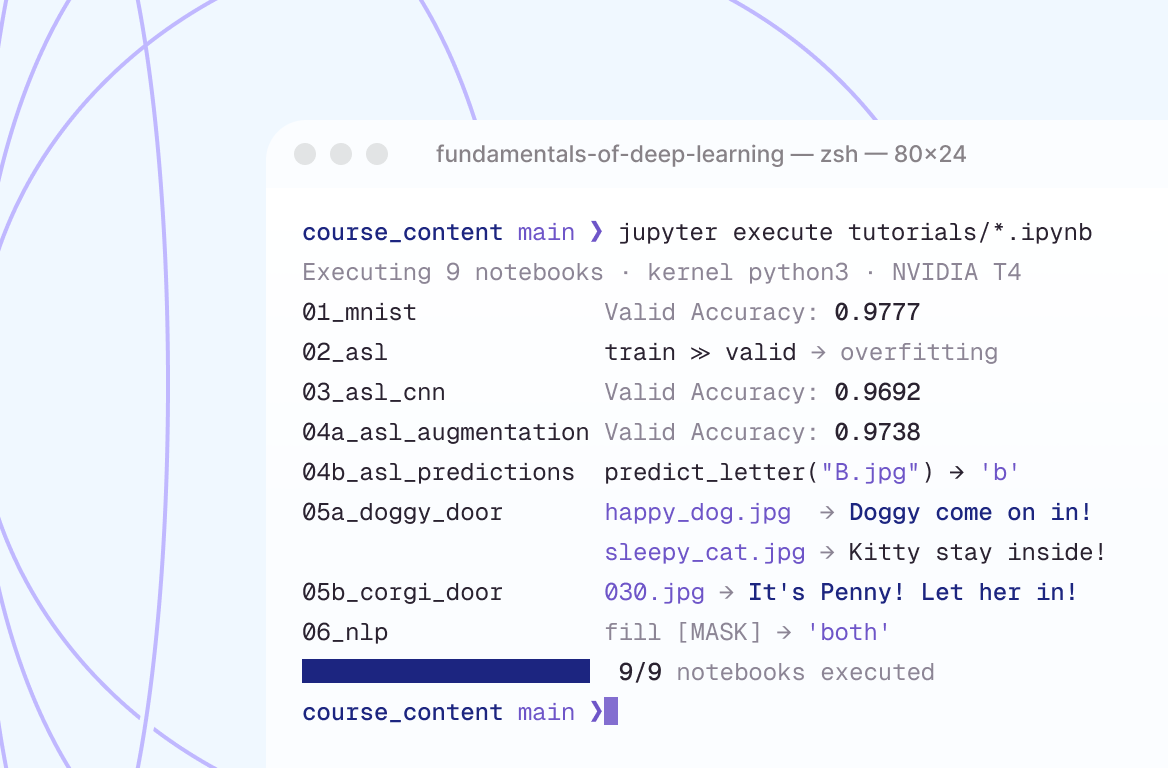
Every module opens a notebook that already runs, and you build on it from there. You train your first image classifier in module one, then a convolutional network that reads American Sign Language letters, then apply data augmentation so it generalizes. In module five you take a pre-trained model and turn it into an automatic doggy door, then use transfer learning so the door opens for one specific dog.
The final module moves from images to text: you train a model on sequential data and see how the same ideas carry over to natural language processing.
Created by NVIDIA, hosted on Nebius Academy
Fundamentals of Deep Learning' is the first open-source from the NVIDIA DLI open-source catalogue to be hosted on Nebius Academy. The curriculum and notebooks are the work of NVIDIA and are published under an open licence. Nebius Academy hosts the course, adds the learning path and awards the badge.
The course is one part of a wider collaboration between Nebius Academy and NVIDIA: courses co-developed by Nebius and NVIDIA engineers, more titles from NVIDIA open-source catalog, and hands-on workshops at Berlin. See all joint initiatives.
What you’ll be able to do
By the end of the course you can:
Train a network
Build and train neural networks in PyTorch on real image datasets.

Classify images with CNNs
Apply convolutional architectures to image classification.
Get more from less data
Use data augmentation and transfer learning to improve accuracy on small datasets.
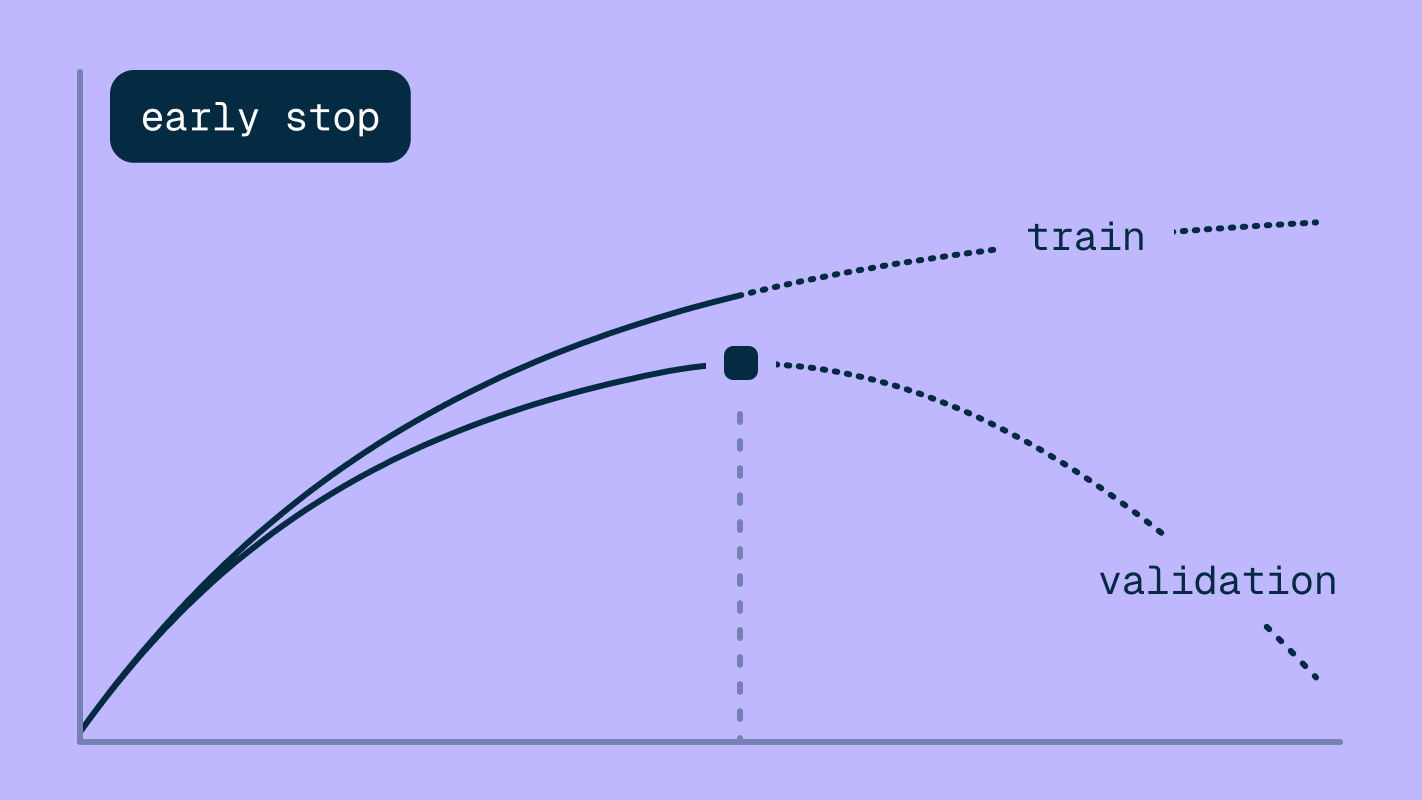
Control overfitting
Manage the bias-variance trade-off and apply techniques to address overfitting.
Run predictions on new data
Save a trained model and use it on images it has never seen.
Curriculum
- What deep learning is and how it differs from writing rules by hand
- Load and prepare the MNIST handwritten-digit dataset in PyTorch
- Build, train, and evaluate your first image classifier
Every module ends in a notebook you run yourself
The course links to the notebooks on GitHub. Pick the setup that fits you; all three are documented in the repository.


Make your learning rewarding
Earn a digital badge
Receive a Credly digital badge when you complete the course on Nebius Academy.
Challenge your skills with Nebius Certification
We invite you to challenge your skills. Explore a wide range of Nebius certifications, validate your knowledge, and earn an official Nebius certificate.
Start with working code
Six modules, six notebooks, one badge. Free on Nebius Academy.
FAQ
Yes. The course is free to take on Nebius Academy, and the materials are open source on GitHub.
Fundamentals of Deep Learning is created by NVIDIA and hosted on Nebius Academy.
Course code is licensed under the Apache License 2.0; documentation, notebook text, and NVIDIA-created educational media under Creative Commons Attribution 4.0 International. See the repository for full license terms and third-party notices.