
Custom Speculator Training by Nebius Token Factory
From production traffic to a tailored drafter.
Custom Speculator Training is the Token Factory workflow that turns your production data into a draft model shaped for the traffic you actually serve. Bring your dataset (or start from our synthetic seeds), train on Papyrax, and deploy alongside the base model on a Dedicated Endpoint. Faster, steadier inference on the prompt shapes your product sees every day.
Stop accepting the latency a generic drafter leaves on the table. Train the one shaped for your workload.
Throughput on real traffic
A drafter trained on your distribution raises the acceptance rate where it matters. Tokens-per-second improves on the prompt shapes your product actually serves, not on a benchmark someone else picked.
Predictable tail latency
Acceptance rate is about predictability as much as speed. A workload-matched drafter tightens the gap between median and tail latency on the traffic your system sees every day.
Unit economics that scale
Fewer GPU-seconds per request. The lever moves where it matters most: at the volume where successful pilots become expensive steady state.
How the workflow works
Step 1: Bring your data
Prepare datasets in Data Lab. Attach S3-compatible files in place, query production logs, and merge them with the synthetic seed datasets we ship for the priority launch models. Or upload curated JSONL directly through the Post-training console or the Files API.
Step 2: Train
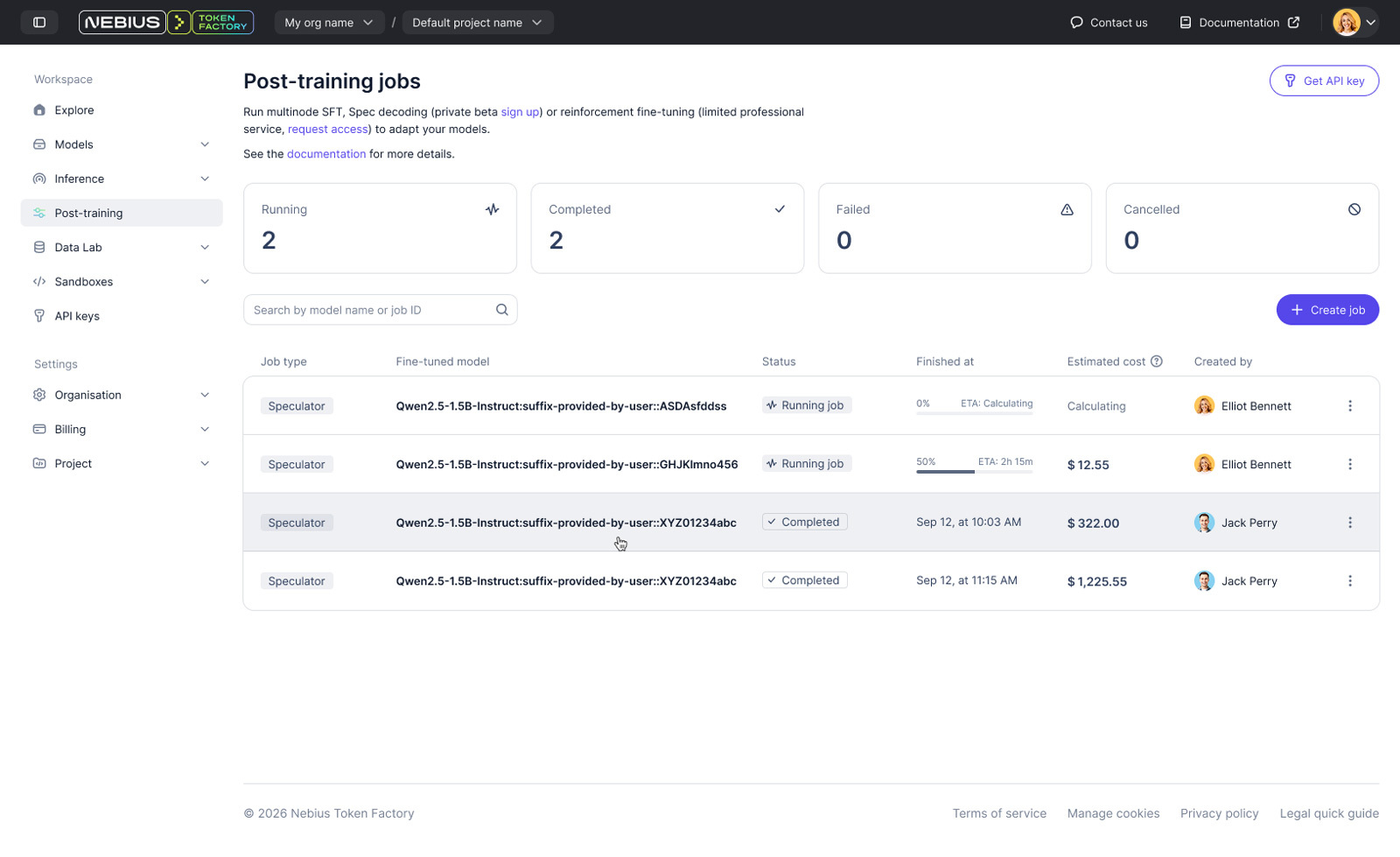
Pick a base model, point at the dataset, run a job from the Post-training page. Preset hyperparameters cover the common case. Full hyperparameter control — decoding heads, loss type, learning rate, scheduler, drafter type — is there for teams that want to tune.
Step 3: Deploy
The trained drafter lands in Custom Weights and deploys on a Dedicated Endpoint alongside the base model. Solutions engineers review the first deploy — a deliberate human-in-the-loop on the part of the stack that affects how your product feels.
Step 4: Measure and retrain
Acceptance rate, TPS, and end-to-end latency sit alongside the rest of your serving metrics. When the workload changes materially, retrain. The cadence becomes part of how you operate the model.

Train better drafters from real data

Train on production data
Use Data Lab to inspect inference logs, isolate the failure cases that matter, and assemble a workload-shaped training set. Bring data from S3-compatible storage without copying it into a separate store.

Tune without rewriting your stack
Start from preset hyperparameters or open up the full configuration surface — decoding heads, loss function, scheduler, drafter type. Built on Papyrax, our production training framework.

Deploy on a Dedicated Endpoint
The trained drafter deploys alongside the base model with the same isolation, region, and SLO rules as the rest of your endpoint. Acceptance rate, TPS, and end-to-end latency stream into the same dashboards.
Documentation and guides
Read the docs, walkthroughs, and research that explain how Custom Speculator Training works end to end.
From production data to drafter
Step-by-step guide from dataset preparation in Data Lab to a deployed custom drafter on a Dedicated Endpoint.
LK Losses and the research behind it
The loss function we use directly optimizes draft-token acceptance rate instead of proxying through KL divergence. Paper, code, and the SpecForge contribution.
Operating in production
How to measure acceptance rate and TPS, decide when to retrain, and roll new drafters into a running endpoint without disrupting serving.
One workspace for model improvement
One workspace for model improvement
Custom Speculator Training plugs into a Token Factory loop that’s already running. Post-training has been live since December 2025. Data Lab v2 launched in May 2026 with S3 import and the dataset merge workflow. RL Platform v1 entered private preview in early June. Custom Speculator is the moment the loop closes — customers shape both model behavior and serving behavior on their own data, in one platform.
Built on open research
Our team’s work on LK Losses introduces a loss function that directly optimizes draft-token acceptance rate instead of proxying it through KL divergence.
Across model sizes from 8B to 685B parameters, LK Losses show consistent acceptance-rate gains over KL-trained baselines. The implementation is open in our SpecForge contribution and the LK-Speculators model family on Hugging Face.
The training pipeline runs on Papyrax, the same distributed training framework powering Post-training since December 2025.
Questions and answers
It’s workload-dependent. The gain depends on how concentrated your prompt distribution is, how much your generic drafter is leaving on the table today, and how much production data you can train on. The honest answer is that a workload-shaped drafter raises the acceptance-rate ceiling that a generic drafter sets — we’ll scope a real number with you on a sample of your data.