
FinOps efficiency for AI workloads with FOCUS-compliant billing data
FinOps efficiency for AI workloads with FOCUS-compliant billing data
We recently introduced support for exporting billing data from Nebius AI Cloud in the FOCUS format. This update is a small but important step toward making cloud integration simpler and financial operations smoother for teams building and scaling AI workloads.
At Nebius, we believe billing data should be easy to work with, easy to integrate and easy to trust — especially when AI infrastructure costs are a core part of your business model.
“As a growing community of practitioners, we see every day how inconsistent billing data creates unnecessary friction — slowing integrations and frustrating FinOps teams. It’s encouraging to see more organizations operating at the AI infrastructure level adopt FOCUS and make uniform, consistent and normalized billing data available to their customers.”
Shawn Alpay, FOCUS Working Group Chair
Why billing visibility matters for AI businesses
Building an AI business today almost always means relying on a chain of technologies: infrastructure providers, managed services, SaaS platforms and specialized tooling from different vendors. Each of them contributes not only to your product, but also to your cost structure.
Together, these vendors generate a continuous stream of billing and usage data that ultimately defines a company’s unit economics. When this data is structurally consistent and preserves its financial integrity across sources, leadership teams can rely on it to make informed decisions about growth, efficiency and profitability.
For FinOps teams, however, reality often looks different. Before any meaningful analysis can happen, billing data from each vendor must be ingested, normalized and reconciled. When every provider uses a different schema, this work quickly turns into manual effort, operational overhead and delays in reporting.
FinOps teams need uniform billing data
Uniformity shifts the focus from data preparation to insight generation. Without it, every new vendor added to the stack introduces friction: new ingestion logic, new mappings and new edge cases.
As new tools, platforms or providers are added, uniform, consistent and normalized billing data formats make integration faster and far less painful, which is especially valuable for growing startups laying the groundwork for long-term financial discipline.
Most importantly, normalization allows FinOps professionals to refocus their time on what actually matters: deeper analysis, better insights and smarter decisions, instead of ongoing data reconciliation.
What FOCUS brings to billing data
FinOps Open Cost and Usage Specification (FOCUS) is an open, vendor-neutral specification designed to make billing data truly interoperable across providers and tools.
FOCUS doesn’t just define a common schema — it establishes shared semantics for cost, usage, attribution and time periods. This makes billing data easier to validate, easier to compare across vendors and easier to plug into existing FinOps tooling, without custom transformations.
The export contains detailed hourly information about everything that affects your invoice: used and unused consumption, adjustments and taxes. You can track the effective price of resources after discounts and drill down to specific virtual machines for precise attribution. It also exposes unused commitments showing the remaining prepaid quantity or cost, so you can optimize your strategy and eliminate waste.
Exporting billing data in the FOCUS format from Nebius AI Cloud
Nebius AI Cloud now allows you to export your billing data in the FOCUS format.
We follow the FOCUS 1.2 schema and extend it with a small set of Nebius-specific fields to reflect the realities of AI infrastructure. These additions provide more accurate and granular visibility into GPU usage, infrastructure consumption and cost structure — without breaking compatibility with FOCUS-based tooling.
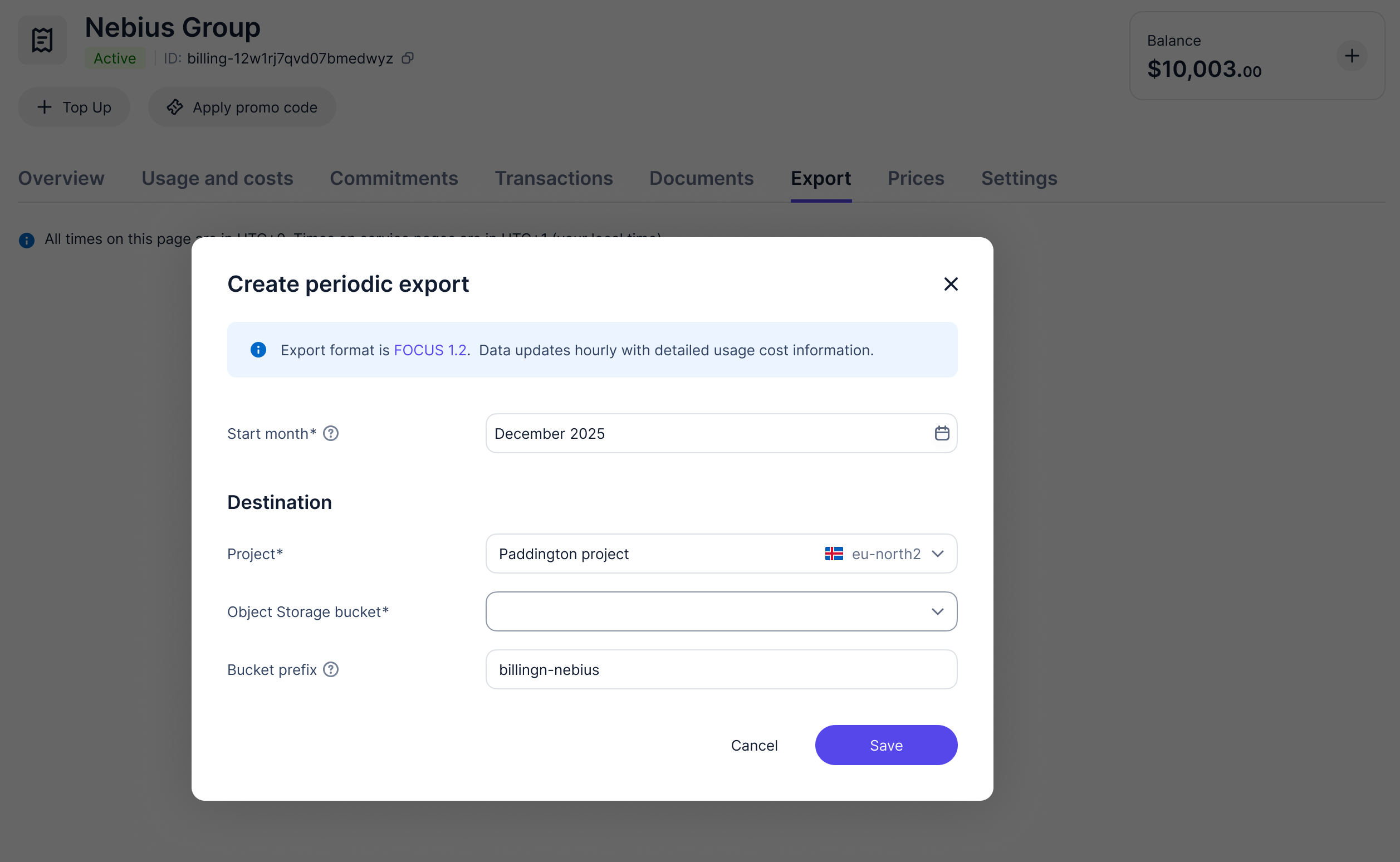 Figure 1. Configuring a billing export from the Nebius web console
You can configure billing exports directly from the Nebius web console by navigating to the Billing section and selecting the Export tab. From there, you define export parameters and choose an Object Storage bucket where the data will be delivered. The export is generated as a CSV file in the FOCUS format. The same workflow is also available via API.
By using the plug-and-play compatibility of FOCUS, you can seamlessly ingest Nebius data into your existing multi-cloud FinOps dashboards without complex mapping, thus making your financial operations future-proof.
Building AI infrastructure that works for the whole organization
At Nebius, we’re building an AI cloud that delivers supercomputer-level performance with a cloud-native experience — not just for developers and engineers, but for everyone involved in operating AI infrastructure.
Uniform, consistent and normalized data is a critical part of that experience. It enables transparency, improves collaboration between technical and financial teams, and gives companies tighter control over their unit economics.
By supporting open specifications like FOCUS, we help our customers spend less time reconciling data and more time understanding their costs. If you want to explore how FOCUS exports work in practice on Nebius AI Cloud, you can start by enabling billing exports in the console or by reviewing the documentation.
Explore Nebius Token Factory

See also

NVIDIA HGX B200 instances are now publicly available as self-service AI clusters in Nebius AI Cloud. This means anyone can access NVIDIA Blackwell — the latest generation of NVIDIA’s accelerated computing platform — with just a few clicks and a credit card.

The Nebius AI Cloud 3.1 release continues the evolution of our platform into a transparent, orchestrated, developer-first environment — where performance is accessible, capacity is visible and control feels effortless. Across new platforms based on NVIDIA Blackwell Ultra, smarter capacity management and an improved experience for both developers and platform operators, every enhancement moves us closer to that goal.

We are introducing updates to the Nebius Status Board to enhance transparency during service outages and provide users with a clearer view of Nebius AI Cloud service availability.