
Nebius and PyTorch partner to accelerate frontier MoE training on NVIDIA Blackwell
Nebius and PyTorch partner to accelerate frontier MoE training on NVIDIA Blackwell
In collaboration with PyTorch, Nebius helped demonstrate up to 41% faster pre-training of DeepSeek-V3 models on NVIDIA Blackwell GPUs.
As model sizes and architectures evolve, training infrastructure must keep pace. Mixture-of-Experts (MoE) models in particular introduce new challenges: large-scale distributed communication, dynamic routing across GPUs and ever-increasing compute demands.
To explore how the latest hardware and software innovations can address these challenges, Nebius and PyTorch collaborated on a set of experiments training DeepSeek-V3 models using TorchTitan on a 256-GPU NVIDIA HGX B200 cluster running in Nebius Cloud.
The results demonstrate how advances in both numerical formats and distributed communication can significantly improve large-scale model training performance.
Up to 41% faster training
The joint experiments evaluated two optimizations on top of a BF16 baseline:
- MXFP8 training via TorchAO, leveraging NVIDIA Blackwell FP8 tensor cores to accelerate performance;
- DeepEP communication, a GPU-initiated expert-parallel communication backend designed for MoE workloads.
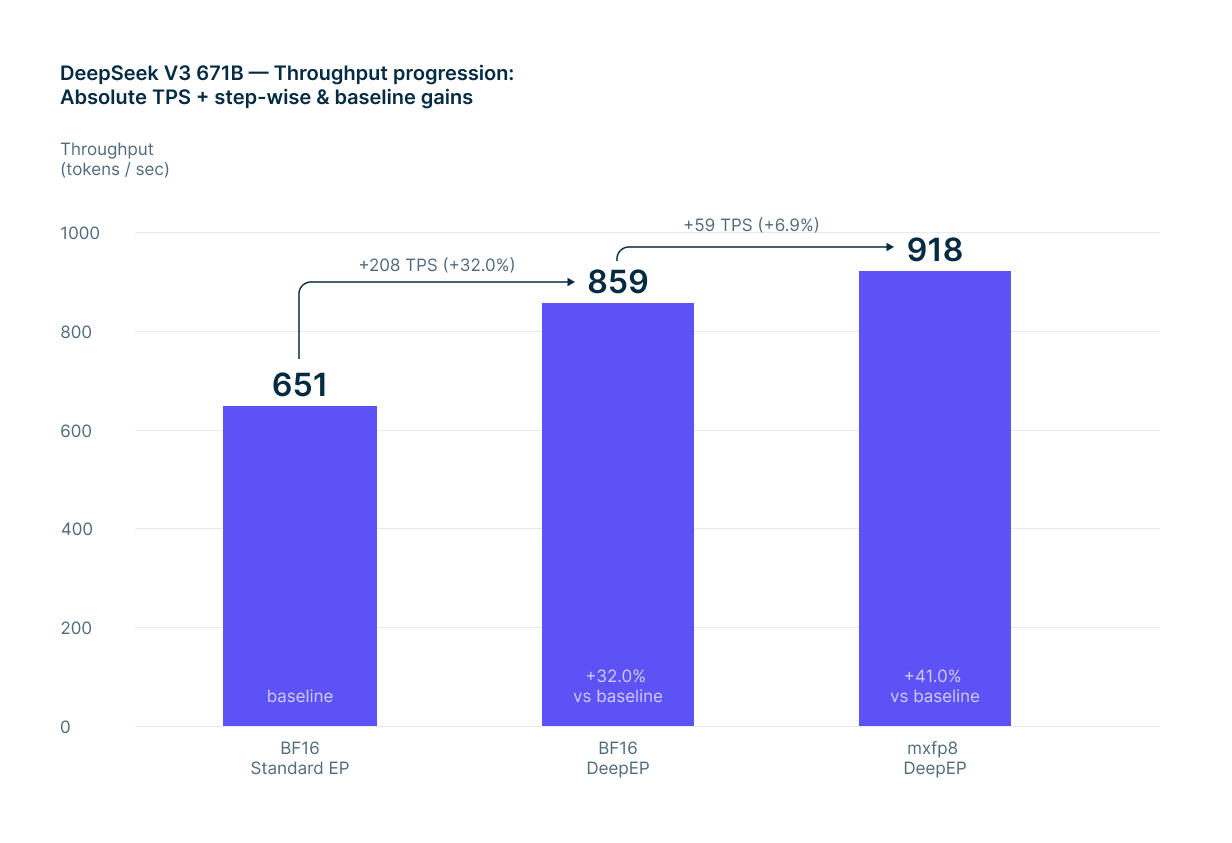
Running on 32 nodes (256 NVIDIA HGX B200 GPUs) in Nebius Cloud, the team observed:
- +32% training throughput using DeepEP alone;
- +41% total throughput improvement when combining DeepEP with MXFP8 for grouped GEMMs.
For the DeepSeek-V3 671B model, throughput increased from 651 tokens/sec to 918 tokens/sec.
The experiments also verified that MXFP8 maintains equivalent convergence behavior to BF16, based on loss-curve validation using the 16B MoE variant.
Infrastructure built for frontier training
All experiments ran on a Nebius Cloud cluster optimized for large-scale AI workloads:
- 256 NVIDIA HGX B200 GPUs across 32 nodes;
- NVIDIA NVLink / NVSwitch for high-bandwidth intra-node communication;
- NVIDIA Quantum InfiniBand networking for inter-node scale;
- Soperator, Nebius’ scheduling system combining Slurm-style semantics with Kubernetes.
Soperator continuously monitors GPU and interconnect health and automatically replaces underperforming nodes. Combined with built-in observability and automated cluster scaling, this allowed the team to focus on training optimization rather than cluster operations.
Open and reproducible
All experiments were performed using open-source, PyTorch-native tooling, including:
- TorchTitan for pre-training;
- TorchAO for MXFP8 mixed-precision training;
- DeepEP for expert-parallel communication.
The full training configurations and scripts are available in the Nebius ML-Cookbook repository, enabling others to reproduce the experiments on Blackwell-based clusters.
A joint step toward faster AI training
This collaboration highlights how hardware capabilities, open-source frameworks, AI software and optimized infrastructure must evolve together to unlock the next generation of large-scale frontier AI models.
By combining NVIDIA Blackwell GPUs, PyTorch tooling and Nebius’ AI-optimized cloud infrastructure powered by NVIDIA Blackwell GPUs, the work demonstrates a practical path to significantly improving the performance and cost-efficiency of MoE training.
For the full technical deep dive, read the PyTorch blog and check out our GitHub page.
Explore Nebius Token Factory
See also
Nebius and Eigen AI are partnering to bring optimized frontier open-source models to Nebius Token Factory. As part of the collaboration, optimized implementations of models such as DeepSeek, GLM, GPT-OSS, Kimi, Llama, MiniMax and Qwen will be published on the platform, giving developers direct access to high-performance inference through production-ready endpoints and APIs.
Nexla and Nebius are partnering to deliver a production-ready data and agent stack that connects governed enterprise data with infrastructure built for sustained inference. In this post, we outline how this architecture enables multi-agent systems to move from fragmented data pipelines to reliable production workflows, and show it in action through a live “Inspiration to Trip” demo presented with Tripadvisor at NVIDIA GTC.

NVIDIA HGX B200 instances are now publicly available as self-service AI clusters in Nebius AI Cloud. This means anyone can access NVIDIA Blackwell — the latest generation of NVIDIA’s accelerated computing platform — with just a few clicks and a credit card.